
Unmanned agricultural sprayers are agricultural machines designed to perform crop protection spraying with reduced direct operator involvement during the spraying operation. Depending on the equipment configuration, the term may include remotely controlled machines, autonomous platforms, agricultural robots and other intelligent spraying systems.
The technology is attracting attention because agricultural spraying often combines several operational challenges: repeated machine movement, chemical exposure, difficult terrain, restricted access and the need to maintain consistent spraying performance. Unmanned or remotely operated equipment can address some of these challenges by separating the operator from the machine or by automating parts of the operation.
However, not all unmanned agricultural sprayers work in the same way. A large autonomous field sprayer, a remotely controlled crawler spraying robot and an unmanned boom sprayer may serve different agricultural environments and require different technologies.
For agricultural machinery distributors, importers, contractors and procurement teams, understanding these differences is essential before selecting equipment.
What Are Unmanned Agricultural Sprayers?
An unmanned agricultural sprayer is a spraying machine that can perform agricultural spraying without an operator continuously riding on or directly controlling the machine from the conventional driving position.
The level of automation can vary significantly.
Some machines are remotely controlled. The operator controls movement and machine functions from a safe distance.
Other systems may use automated navigation or intelligent control technologies to perform defined operations with less direct intervention.
Because these technologies differ, buyers should not assume that every unmanned agricultural sprayer has the same level of autonomy.
A useful way to understand the equipment is to separate three concepts:
Remotely Controlled Sprayers
A remotely controlled agricultural sprayer is operated by a person using a remote-control system rather than sitting on the machine.
This configuration can be useful when reducing direct operator exposure to the spraying area is an important consideration.
The operator remains responsible for supervising and controlling the machine.
Autonomous Agricultural Sprayers
Autonomous sprayers use navigation, positioning, sensing or programmed operating systems to perform certain movements or agricultural tasks with reduced direct manual control.
The actual degree of autonomy depends on the machine and its control configuration.
Agricultural Spraying Robots
Agricultural spraying robots generally combine a mobile platform with a spraying system and an electronic or remote-control system.
The platform may be designed around specific agricultural environments, such as restricted-access areas or terrain where conventional wheeled equipment may not be the preferred option.
How Unmanned Agricultural Sprayers Work
An unmanned agricultural sprayer should be understood as an integrated equipment system rather than simply a vehicle carrying a spray tank.
The main system typically combines:
Mobile platform
Spraying system
Pump and fluid delivery system
Tank system
Spray nozzles
Control system
Power system
The configuration of these components determines where and how the equipment can be used.
The Mobility Platform
The mobility platform allows the sprayer to move through the agricultural operating environment.
Different platforms may use wheels, crawler tracks or other mobility systems.
The choice of platform is closely connected to terrain, ground conditions, machine access and turning requirements.
For example, crawler-based agricultural equipment can provide different mobility characteristics from conventional wheeled equipment. A crawler platform may be particularly relevant where ground conditions, slopes or restricted movement paths require strong terrain adaptability.
The Spraying System
The spraying system transports liquid from the tank through the pump and distribution system to the nozzles.
Important technical factors include:
Working pressure
Pump capacity
Liquid flow
Nozzle configuration
Spray direction
Coverage requirements
These factors affect how the spraying system performs and should be evaluated according to the intended agricultural application.
The Control System
The control system manages machine functions.
Depending on the equipment design, this may include remote operation, electronic control or automated functions.
For remotely controlled equipment, communication distance and operating reliability are practical considerations because the operator must maintain effective control of the machine within the intended working environment.
Spray Nozzles and Application Output
Nozzles are a critical part of any agricultural spraying system.
Nozzle configuration influences the direction and distribution of the spray. Different nozzle designs and angles may be selected according to equipment configuration and agricultural requirements.
Buyers should evaluate nozzle systems together with pressure, pump performance and the intended application rather than treating nozzle selection as an isolated specification.
Why Unmanned Agricultural Sprayers Are Used
The benefits of unmanned agricultural spraying depend heavily on the equipment type and operating environment.
Reduced Direct Operator Exposure
One of the most practical advantages of remotely operated spraying equipment is that the operator does not need to remain on the machine during operation.
This can increase the physical separation between the operator and the spraying area.
For equipment buyers, this is particularly relevant when evaluating crop protection operations where reducing direct exposure is an operational objective.
Improved Access in Difficult Agricultural Environments
Some agricultural areas are difficult for conventional equipment to access efficiently.
Terrain, narrow paths, orchard layouts, slopes and restricted turning space can influence equipment selection.
Compact unmanned platforms or crawler-based spraying machines may provide a different approach to machine mobility in these environments.
Reduced Dependence on Continuous Onboard Operation
Traditional self-propelled equipment generally requires an operator to remain on the machine during operation.
Remote-control and unmanned systems can change this operating model.
This does not eliminate the need for supervision, preparation, maintenance or operational management. Instead, it changes how the operator interacts with the machine.
Potential for More Automated Agricultural Operations
Unmanned agricultural sprayers can also form part of broader agricultural automation systems.
Depending on equipment technology, automation may involve machine movement, spraying functions, electronic control or integration with other agricultural systems.
The practical value of automation depends on whether the technology matches the actual agricultural operation.
Agricultural Applications of Unmanned Spraying Equipment
Unmanned spraying equipment is not equally suitable for every crop or agricultural environment.
Equipment selection should begin with the operating environment.
Orchard Crop Protection
Orchards can create specific machinery challenges because tree structures, pathways and terrain may limit machine movement.
Equipment may need to operate through relatively restricted spaces while maintaining appropriate mobility.
Crawler spraying platforms can be relevant to certain orchard environments because their mobility system is designed differently from conventional wheeled machines.
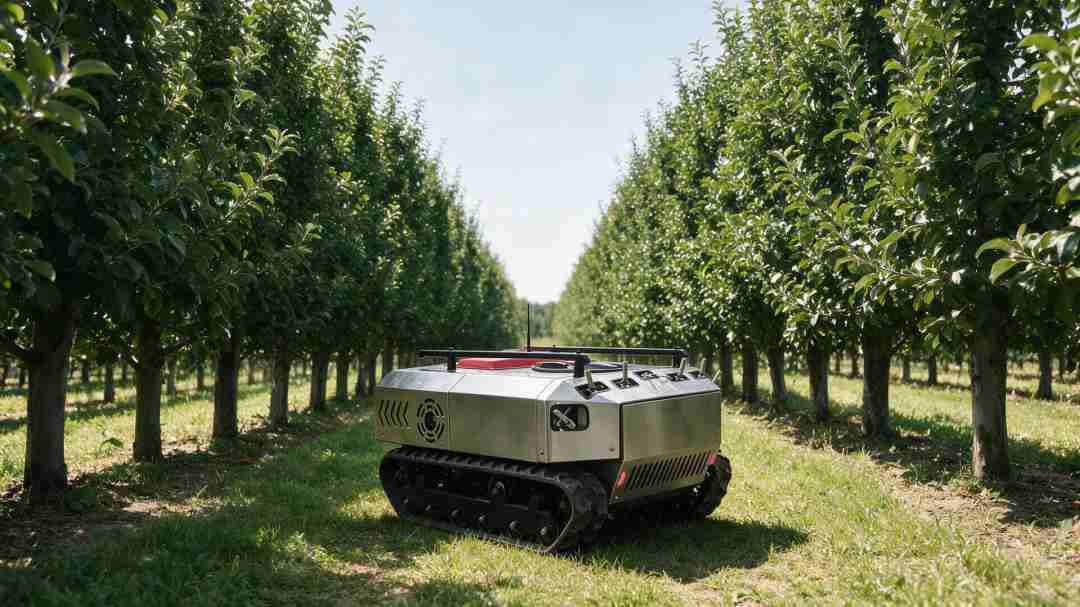
The 3WZD-200 Crawler Plant Protection Robot provided by DUOJIA is an example of a remotely controlled crawler-based spraying machine intended for orchard plant protection, particularly enclosed orchard environments.
Its configuration includes crawler self-propulsion with remote control and differential steering.
The machine can turn through differential steering and is designed with a crawler chassis for agricultural mobility.
However, buyers should evaluate orchard equipment according to the actual layout of the orchard rather than assuming that one platform is suitable for every orchard.
Important considerations include:
Access width
Terrain
Slope
Turning requirements
Tree structure
Spray coverage requirements
Operator control requirements
Sloping and Uneven Agricultural Areas
Terrain can significantly affect agricultural machinery selection.
A machine designed for flat, open fields may have different mobility requirements from equipment operating on slopes or uneven ground.
Crawler platforms can be considered when traction, climbing capability and machine movement over uneven agricultural surfaces are important factors.
The 3WZD-200 Crawler Plant Protection Robot has a stated maximum working slope of 30°.
This specification should be considered together with actual site conditions, ground stability, operating procedures and safety requirements.
Restricted-Access Agricultural Operations
Some agricultural operations involve spaces where large boom equipment is difficult to maneuver.
Compact remotely controlled machines can provide an alternative equipment category where access and mobility are more important than large-scale field coverage.
The correct equipment choice depends on the relationship between the agricultural environment and the machine design.
A Practical Example: Crawler-Based Agricultural Spraying
The 3WZD-200 Crawler Plant Protection Robot demonstrates how a remotely controlled agricultural sprayer can combine mobility and crop protection functions.
According to the provided product information, the machine has:
A crawler self-propelled structure
Remote control
Differential steering
A 200 L rated chemical tank capacity
Working pressure of 8–12 MPa
A spray width of 6–10 m
Six spray nozzles
A rated pump flow of 25 L/min
A maximum travel speed of 1.06 m/s
A maximum working slope of 30°
An effective remote-control distance of no more than 500 m
The nozzle system uses fan-shaped nozzles, with 40°, 65° and 80° configurations available as options according to the supplied specifications.
The machine dimensions are 1420 × 1100 × 720 mm, and the crawler specification is 180 × 72 × 38.
This type of equipment is relevant to the broader topic of unmanned agricultural sprayers because it demonstrates an important distinction: unmanned operation does not necessarily mean fully autonomous operation.
A remotely controlled agricultural robot still requires an operator, but the operator can control the machine from a distance.
Key Technologies Behind Unmanned Agricultural Sprayers
The performance and suitability of unmanned agricultural spraying equipment depend on the interaction of several technologies.
Remote-Control Technology
Remote control allows the operator to manage machine movement and functions without riding on the equipment.
When evaluating remotely controlled sprayers, buyers should check:
Effective operating distance
Control functions
Machine response
Operating environment
Potential communication obstacles
Safety procedures
The control system should be evaluated according to the actual working environment rather than only by its maximum stated communication distance.
Electronic and Intelligent Control
Electronic control can manage specific machine functions and may support more consistent operation compared with purely mechanical control methods.
Depending on equipment configuration, intelligent agricultural machinery may integrate different forms of electronic control.
Buyers should clearly distinguish between:
Remote control
Electronic control
Automated functions
Autonomous navigation
These terms should not be treated as interchangeable.
Crawler Mobility Systems
Crawler platforms distribute machine movement through tracks rather than conventional wheels.
For agricultural spraying applications, crawler systems can be relevant where terrain adaptability, turning characteristics or ground conditions influence equipment selection.
The mobility system should always be evaluated together with the machine's overall dimensions, operating environment and agricultural task.
High-Pressure Spraying Systems
Some agricultural spraying machines use high-pressure systems to deliver liquid through the nozzle system.
Pressure alone does not determine spraying suitability. The complete system must be considered.
This includes:
Pump performance
Nozzle configuration
Spray direction
Operating pressure
Liquid distribution
Agricultural application requirements
Benefits and Limitations of Unmanned Agricultural Sprayers
Unmanned agricultural sprayers can provide practical benefits, but they also introduce different operational requirements.
Main Potential Benefits
Remote operation can increase separation between the operator and the spraying area.
Compact robotic platforms can improve access in some restricted agricultural environments.
Crawler systems can provide different mobility characteristics for challenging terrain.
Electronic and remote-control technologies can support more automated agricultural operations.
The equipment can reduce the need for continuous onboard operation.
Practical Limitations
Unmanned equipment is not automatically suitable for every farm.
Machine selection still depends on crop structure, terrain, access and required spraying method.
Remote-controlled equipment requires trained operators and appropriate supervision.
Communication conditions can affect remote operation.
Maintenance requirements remain important because spraying systems, pumps, nozzles and mobility components require regular inspection.
The appropriate level of automation depends on the agricultural operation.
For these reasons, buyers should evaluate unmanned spraying equipment as a complete agricultural system rather than purchasing based only on the term "unmanned."
How B2B Buyers Should Select Unmanned Agricultural Sprayers
For distributors, importers and agricultural project buyers, equipment selection should begin with the intended operating environment.
Define the Agricultural Application
The first question is what the machine must actually do.
Consider:
Crop environment
Field or orchard layout
Terrain
Access conditions
Required spraying method
Operating frequency
This information helps determine whether a boom sprayer, crawler spraying robot, remotely controlled machine or another equipment type is more appropriate.
Evaluate Mobility Requirements
Mobility should match the agricultural environment.
Buyers should examine:
Machine dimensions
Turning method
Ground clearance
Mobility platform
Slope requirements
Access routes
For crawler equipment, track design and terrain conditions are also relevant.
Check the Spraying System
The spraying system should be evaluated as a complete technical configuration.
Important information includes:
Tank capacity
Pump flow
Working pressure
Nozzle quantity
Nozzle type
Spray width
The required values depend on the agricultural operation.
Understand the Control Method
Buyers should ask whether the equipment is:
Manually operated
Remotely controlled
Partially automated
Autonomous
This distinction affects operator requirements, technical training and project planning.
Request Technical Documentation
For international agricultural machinery procurement, technical documentation is important.
Buyers may need information covering:
Product specifications
Operating instructions
Maintenance requirements
System configuration
Compatible components
Control functions
Clear technical communication is particularly important when equipment is being imported, distributed or integrated into an agricultural project.
Maintenance Considerations for Unmanned Spraying Equipment
Automation does not remove the need for routine agricultural machinery maintenance.
Spraying equipment requires attention to both the machine platform and the liquid application system.
Inspect the Spraying System
Regular inspection should consider:
Pump condition
Fluid lines
Nozzles
Connections
Tank cleanliness
Nozzle condition is particularly important because blockage, wear or damage can affect spray distribution.
Maintain the Mobility System
Crawler-based equipment requires inspection of the track system and related mechanical components.
Maintenance requirements should follow the equipment manufacturer's operating documentation.
Check Remote-Control Functions
Remote-control equipment should be inspected to ensure that control functions respond correctly before operation.
The operating environment should also be considered because obstacles or site conditions may affect practical machine control.
Frequently Asked Questions About Unmanned Agricultural Sprayers
FAQ
What is an unmanned agricultural sprayer?
An unmanned agricultural sprayer is a crop protection machine designed to perform spraying without requiring an operator to continuously ride on the equipment. It may be remotely controlled, automated or autonomous depending on the machine configuration.
Are all unmanned agricultural sprayers autonomous?
No. Some unmanned sprayers are remotely controlled by an operator. Remote operation and autonomous operation are different technologies and should be evaluated separately.
Where are agricultural spraying robots commonly considered?
Agricultural spraying robots can be considered for environments where machine mobility, restricted access, terrain or operator separation are important factors. Suitability depends on the specific equipment and agricultural conditions.
Why use a crawler platform for agricultural spraying?
Crawler platforms provide different mobility characteristics from wheeled machines and may be relevant where terrain, slopes, turning requirements or agricultural access conditions influence equipment selection.
What specifications should buyers check before purchasing an unmanned sprayer?
Relevant specifications may include machine dimensions, mobility system, tank capacity, pump performance, working pressure, nozzle configuration, spray width, operating speed and control method.
What is the difference between a remote-controlled sprayer and an autonomous sprayer?
A remote-controlled sprayer is actively controlled by an operator from a distance. An autonomous sprayer uses programmed or automated systems to perform some operations with reduced direct control. The actual capabilities depend on the equipment configuration.
Can unmanned agricultural sprayers replace conventional sprayers?
Not necessarily. The appropriate equipment depends on the agricultural operation. Conventional, remotely controlled and autonomous equipment may each be suitable for different environments and operational requirements.
Conclusion
Unmanned agricultural sprayers represent a growing category of agricultural automation equipment that combines crop protection systems with remote control, intelligent control or automated machine functions.
Their value depends on practical operating requirements rather than the technology label alone.
For difficult terrain, restricted agricultural access or operations where reducing direct onboard exposure is important, remotely operated spraying platforms can provide a different equipment approach from conventional operator-driven machines.
Crawler-based equipment such as the 3WZD-200 Crawler Plant Protection Robot illustrates how remote control, agricultural mobility and a dedicated spraying system can be integrated into one machine for orchard plant protection applications.
For B2B buyers, the most important selection principle is to start with the agricultural environment and operating requirement. Terrain, crop structure, access, spraying configuration, mobility and control method should all be evaluated before selecting an unmanned agricultural sprayer.
Contact Us
For information about agricultural spraying equipment, intelligent agricultural machinery and related application technologies, contact Hefei Duojia Agricultural Technology Co., Ltd. through to discuss relevant equipment requirements.