
Tank capacity is one of the most visible specifications when selecting an agricultural sprayer, but its importance goes beyond the number of liters a tank can hold. Capacity affects how frequently the machine needs to return for water or spray-mix replenishment, how long it can continue an operation before stopping, and how the sprayer fits into the overall logistics of a field operation.
For agricultural machinery buyers, distributors, contractors, growers, and procurement teams, the key question is not simply whether a tank is large or small. The more useful question is whether the tank capacity matches the sprayer's application requirements, operating environment, mobility, and refill arrangements.
A suitable tank capacity can help balance operating continuity with machine size and handling requirements. This article explains the relationship between tank capacity and agricultural sprayer selection, with practical considerations for evaluating equipment for field operations.
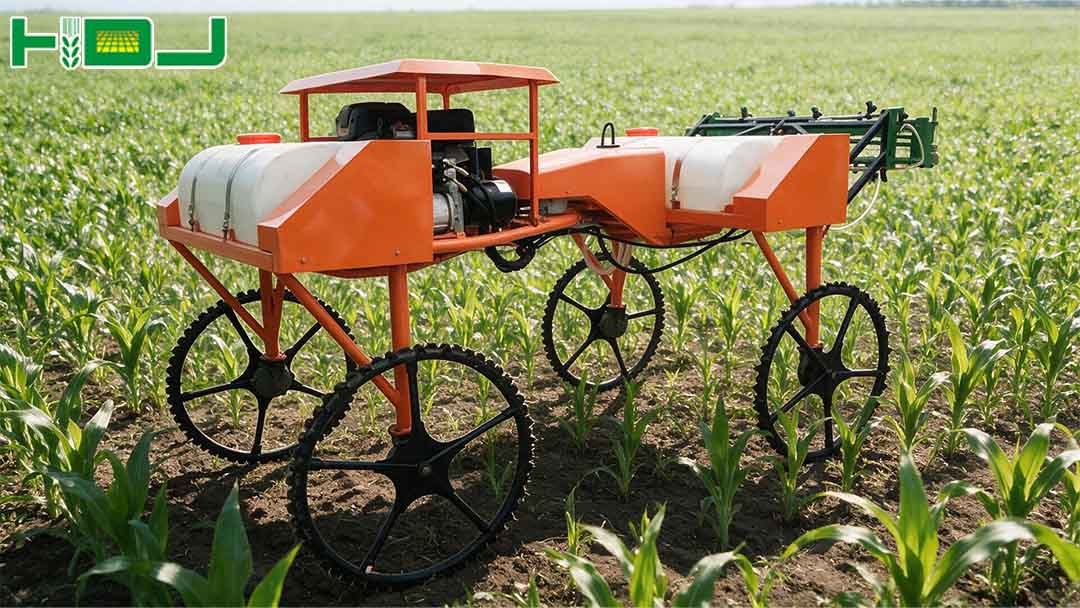
What Is Agricultural Sprayer Tank Capacity?
Agricultural sprayer tank capacity is the nominal volume of liquid that the sprayer tank is designed to contain. It is commonly expressed in liters.
The tank is part of the sprayer's fluid-handling system. During operation, liquid is supplied from the tank to the spraying system, where it is distributed through the relevant delivery and application components.
Tank capacity should therefore be considered together with factors such as:
Application volume
Working width
Operating speed
Field size
Refill availability
Field layout
Machine mobility
Ground conditions
Overall machine configuration
A tank capacity that appears large in isolation may not provide a practical advantage if the machine is difficult to operate in the intended field environment. Conversely, a smaller tank may require more frequent refilling, which can interrupt field work when water or spray-mix supply points are far from the operating area.
Why Does Tank Capacity Matter for Field Efficiency?
The most direct relationship is between tank capacity and refill frequency.
If other operating factors remain unchanged, a larger tank can generally hold more liquid before the next refill is required. This can allow longer continuous operation between stops. A smaller tank may require more frequent replenishment.
However, field efficiency is not determined by tank capacity alone.
A sprayer's practical field efficiency depends on the interaction between liquid capacity, application requirements, working width, operating speed, field conditions, turning requirements, travel distance to refill points, and the time required for refilling.
This means that increasing tank capacity does not automatically produce a proportional increase in total field productivity.
For example, a larger tank can reduce the number of refill stops, but the larger machine may also have different mobility requirements. The appropriate balance depends on the complete operating system.
How Tank Capacity Affects Refill Frequency
Refilling is a non-spraying activity, so time spent traveling to a water source, preparing the next load, filling the tank, and returning to the field can reduce productive operating time.
Tank capacity affects this process in a straightforward way.
A larger capacity may allow more spray liquid to be carried during each operating cycle. If the application requirement and other conditions remain comparable, this can increase the area covered between refill events.
A smaller capacity means that the machine reaches its available liquid volume sooner. This can increase the frequency of refill operations.
For B2B buyers, refill frequency should therefore be evaluated together with the location and organization of the water supply system. A machine working close to a convenient refill point may operate effectively with a different tank capacity from a machine working across large fields where replenishment requires significant travel.
Tank Capacity Must Match Application Requirements
Tank capacity should not be evaluated separately from the amount of liquid applied during operation.
The relationship can be expressed conceptually as:
Available tank volume → application volume → operating distance or area → refill requirement
If the application volume is high, a given tank capacity will be consumed more quickly. If the application volume is lower, the same tank can support a longer operating cycle.
Application volume itself depends on the specific spraying operation and equipment configuration. It should not be assumed that one tank capacity is suitable for every crop, field, or spraying program.
For equipment selection, buyers should first establish the intended operating requirements and then evaluate whether the available tank capacity supports practical field logistics.
Tank Capacity and Working Width
Working width is another important factor when considering tank capacity.
A wider spraying system can cover more ground during each pass, while a narrower system covers less ground per pass. Because the rate of area coverage changes with operating width and speed, the relationship between tank volume and field coverage also changes.
This is why two sprayers with the same tank capacity can have different practical operating patterns.
For procurement teams, tank capacity should therefore be reviewed alongside the machine's documented working width rather than treated as an independent measure of productivity.
A tank may be technically adequate in terms of volume while still being poorly matched to the intended field operation if the rest of the sprayer configuration does not meet the required operating conditions.
Tank Capacity and Operating Speed
Operating speed also influences how quickly a sprayer progresses through a field.
When working width and application conditions are considered together, operating speed affects the rate at which field area is covered. Tank capacity then determines how much liquid is available before replenishment becomes necessary.
This creates an important equipment-selection relationship:
Tank capacity + application requirement + working width + operating speed = operating cycle characteristics
The actual result depends on the machine and operating conditions. Buyers should use documented specifications rather than assuming that a larger tank or higher travel speed alone will determine field efficiency.
Larger Tank vs. Smaller Tank: What Should Buyers Consider?
There is no universal tank capacity that fits every agricultural spraying operation.
A larger tank can provide greater liquid-carrying capacity and may reduce the frequency of refill events. However, buyers should also consider the complete machine configuration and operating environment.
A smaller tank can be appropriate where:
Refill facilities are readily accessible
Fields are relatively small or fragmented
Machine size must remain compact
Frequent changes between operating areas are expected
Mobility is more important than extended liquid-carrying capacity
A larger tank may be relevant where:
Longer operating cycles are required
Refill points are relatively distant
Field logistics support larger liquid loads
The overall machine configuration is suitable for the intended environment
These are general equipment-selection principles. The appropriate choice depends on the actual spraying operation and machine configuration.
How Tank Capacity Affects Overall Machine Selection
Tank capacity is only one part of a complete agricultural sprayer specification.
A buyer should also examine:
Machine Configuration
Tank volume needs to be compatible with the machine's overall structure, dimensions, drive system, steering system, and intended operating environment.
A capacity increase should not be evaluated independently from machine mobility or field accessibility.
Spraying System
The tank supplies liquid to the spraying system, so its capacity should be considered together with the intended application method and documented spraying configuration.
Field Conditions
Terrain, field access, crop structure, soil conditions, and field layout can influence whether a particular machine configuration is practical.
Refill Logistics
The distance to water sources and the organization of refill operations can have a major effect on the practical value of tank capacity.
Maintenance and Handling
The tank is part of a working machine rather than a standalone container. Buyers should consider inspection, cleaning, fluid handling, and compatibility with the overall equipment configuration.
A Practical Way to Evaluate Tank Capacity
For B2B equipment selection, the following sequence can help structure the evaluation:
1. Define the spraying operation
Identify the intended agricultural operation and the type of field work involved.
2. Establish the application requirement
Determine the relevant application volume and operating parameters for the intended operation.
3. Review field conditions
Consider field size, access, terrain, crop conditions, and the distance between operating areas and refill points.
4. Evaluate the tank capacity
Determine how the available tank volume fits the expected operating cycle.
5. Check the complete machine configuration
Review working width, operating speed, mobility, control system, dimensions, and other documented specifications that affect suitability.
6. Evaluate refill logistics
Consider how liquid will be supplied, where refilling will occur, and how much non-spraying travel may be required.
7. Compare documented machine specifications
For procurement, compare verified specifications rather than selecting equipment based only on nominal tank size.
This approach helps prevent tank capacity from becoming an isolated purchasing criterion.
Example: 160 L and 270 L Agricultural Sprayers
The related DUOJIA products provide a useful example of why tank capacity should be evaluated as part of a complete specification.
The 3WYP-160 is specified with a 160 L rated tank capacity, a 7 m spray boom, a maximum travel speed of 9 km/h, and a documented operating efficiency of 40 mu/h. It is described as a self-propelled sprayer with three-wheel drive and front-wheel steering. Its rear wheel track is adjustable from 1750 to 2100 mm, and the listed ground clearance is 1.1 m.
The 3WYP-270 is specified with a 270 L rated tank capacity, a 7 m spray boom, a maximum travel speed of 9 km/h, and a documented operating efficiency of 40 mu/h. It uses four-wheel drive and articulated steering. Its listed dimensions are 3220 × 1620 × 1870 mm.
The important point is that the larger tank capacity of the 3WYP-270 should not be interpreted as meaning that tank capacity alone determines field efficiency. The two machines also have different drive and steering configurations and other documented specifications.
This illustrates a broader procurement principle: tank capacity should be compared within the context of the complete sprayer configuration.
Does a Larger Sprayer Tank Always Improve Efficiency?
No. A larger tank can reduce refill frequency under suitable operating conditions, but field efficiency depends on several interacting variables.
A larger capacity may be less useful if:
Refill points are already close to the field
The field is highly fragmented
Machine access is restricted
The operating cycle does not require extended liquid capacity
The overall machine configuration is not suitable for the field
Similarly, a smaller tank does not necessarily mean poor field performance. It may be suitable when refill logistics are efficient and the machine configuration matches the intended operation.
The correct approach is to evaluate tank capacity against the actual operating cycle rather than treating capacity as a standalone measure of productivity.
Questions B2B Buyers Should Ask Suppliers
When evaluating agricultural sprayers, procurement teams can ask suppliers:
What is the rated tank capacity?
What application conditions is the machine designed for?
What are the documented working width and operating speed?
How does the tank capacity fit the intended operating cycle?
What machine dimensions affect field access?
What drive and steering configuration does the machine use?
What refill arrangements should be considered?
Which specifications are standard and which are optional?
What technical documentation is available for the proposed configuration?
These questions help buyers distinguish between a nominal tank specification and the practical suitability of the complete machine.
FAQ
What is the ideal tank capacity for an agricultural sprayer?
There is no single ideal capacity. The appropriate tank size depends on application requirements, field conditions, refill logistics, machine configuration, and the desired operating cycle.
Does a larger tank mean higher field efficiency?
Not necessarily. A larger tank can reduce refill frequency, but total field efficiency also depends on working width, operating speed, field layout, refill distance, mobility, and other equipment factors.
How does tank capacity affect sprayer selection?
Tank capacity influences how much liquid can be carried between refills. It should be evaluated together with the spraying system, working width, operating conditions, machine mobility, and refill arrangements.
Is a smaller tank suitable for professional agricultural operations?
A smaller tank can be suitable when the operating conditions and refill logistics support more frequent replenishment. Capacity should be matched to the complete operating requirement.
Should tank capacity be compared separately when buying agricultural sprayers?
It is better to compare tank capacity as part of the complete machine specification. Other factors such as working width, operating speed, mobility, steering, control systems, and field conditions can affect the practical value of a particular capacity.